What Is Ube? The Filipino Purple Yam Quietly Taking Over Dessert
From Manila markets to Sydney bakeries — the story of the flavour everyone is talking about.
If you have scrolled through social media in the last two years, chances are you have seen it — a vivid, almost electric purple swirled through soft-serve, layered in cakes, or stuffed into something thick and gooey. That colour belongs to ube, the Filipino purple yam, and it is not going anywhere.
What exactly is ube?
Ube (pronounced "oo-beh") is Dioscorea alata — a purple yam native to Southeast Asia and deeply embedded in Filipino culinary tradition. Unlike the more familiar orange sweet potato or the jewel yam you might find in Caribbean cooking, ube has a flavour that is genuinely its own: softly sweet, subtly earthy, with a gentle vanilla-like warmth and a hint of nuttiness that intensifies with cooking.
In the Philippines, ube has been a staple of traditional sweets for generations. Halaya — a thick, jammy ube jam cooked down with coconut milk and condensed milk — has been a fixture at family gatherings, fiestas, and Christmas tables for as long as anyone can remember. It turns up in ensaymada (a fluffy Filipino brioche), in halo-halo (the iconic Filipino shaved ice dessert), and in ube pandesal, the purple bread roll that has become a weekend morning staple across Manila and beyond.
Why does ube taste so different from purple sweet potato?
This question comes up a lot, and it is worth answering properly. Ube and Okinawan sweet potato (the purple sweet potato you sometimes see at health food stores) are different plants with genuinely different flavour profiles. Okinawan sweet potato is earthier and more savoury-adjacent. Ube sits closer to vanilla on the flavour spectrum — it is sweet in a way that feels almost floral, with a creaminess that makes it particularly well-suited to desserts.
The purple colour in ube comes from anthocyanins — the same family of pigments that give blueberries, red cabbage, and açaí their colour. Ube has an unusually high concentration of them, which is why the colour is so vivid and so stable when cooked. It does not fade to grey the way some purple vegetables do. Baked into a cookie or churned into ice cream, it holds that extraordinary hue.
How ube crossed the Pacific and landed in Sydney dessert culture
Filipino food has always been underrepresented on Australia's culinary radar relative to the size and cultural contribution of the Filipino-Australian community. That has been changing rapidly. Ube, specifically, has benefited from a broader wave of interest in Southeast Asian ingredients — partly driven by social media (that colour photographs extraordinarily well), and partly driven by a genuine hunger for flavours that tell a different story from the usual European-derived dessert canon.
Filipino-Australian communities in Western Sydney, Melbourne's northern suburbs, and across the country have been eating ube halaya at family gatherings for decades. What has changed is that the wider Australian food culture is finally catching up — and the timing feels overdue.
How we built a cookie around it
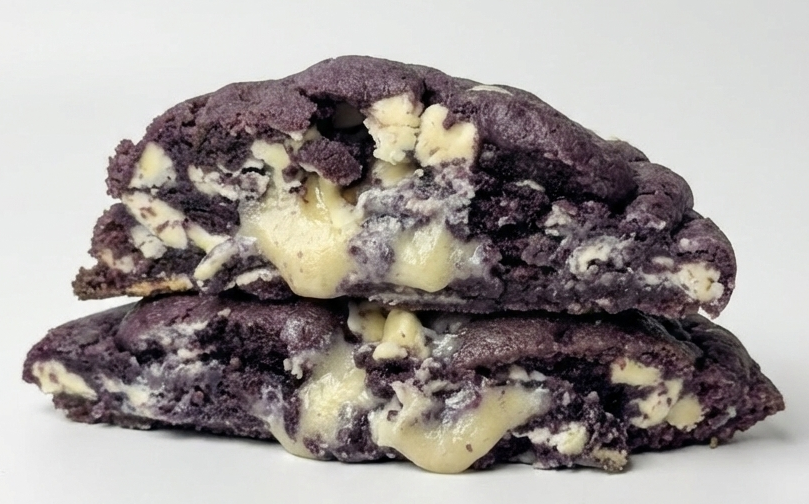
At Chip Bakehouse, ube is personal. Our Ube Cheesecake Cookie was the first flavour we ever developed — and probably the hardest one to get right. The brief was simple in theory: capture the experience of ube halaya, wrapped in a cookie that is thick, gooey, and worth eating at any time of day.
The result is a deeply purple cookie stuffed with a cream cheese and ube halaya centre. The ube flavour is genuine — we use real ube in the filling, not an extract that mimics it at a distance. The colour holds through baking. And the cream cheese provides the tang that makes the sweetness feel balanced rather than cloying.
We knew we had got it right when people who grew up eating halaya at their grandmothers' tables tasted it and recognised something familiar in it. That is the standard we hold ourselves to.
Is ube going to stick around, or is it a trend?
Short answer: it is not going anywhere. The reason ube became a "trend" in the first place is that it genuinely tastes extraordinary and looks unlike anything else on the dessert menu. Those are not transient qualities. What tends to happen with ingredients like this — matcha went through the same cycle — is that the initial wave of novelty cools off and what is left is a genuine, committed audience who simply love the flavour.
That is where ube is headed. It has too much flavour depth, too much cultural resonance, and too much versatility to fade back into obscurity. Filipino cuisine — of which ube is one of the most recognisable ambassadors — is having a long-overdue moment of visibility in Australian food culture, and that is a shift that feels permanent rather than seasonal.
Where to find ube in Sydney
Beyond our own Ube Cheesecake Cookie, ube has been appearing across Sydney's dessert landscape — in bubble tea chains, at Filipino bakeries and grocers, and increasingly at more mainstream cafes and dessert bars who have recognised that their customers are ready for it. If you want to go deeper, a jar of ube halaya from a Filipino grocery store is one of the most useful things you can have in the fridge — it works spread on toast, stirred into oatmeal, or simply eaten by the spoonful.
Or, if you prefer someone else to do the baking, you can build a box with our Ube Cheesecake Cookie and have it delivered across Australia. We bake in small batches, and we will not compromise on the filling.
Frequently asked questions
What does ube taste like?
Ube has a soft, sweet flavour that is often described as a cross between vanilla and coconut, with a subtle earthiness underneath. It is less intensely sweet than you might expect, and has a creamy, almost nutty quality when cooked. The flavour is gentle enough to work as a background note but distinctive enough to be immediately recognisable.
Is ube the same as purple sweet potato?
No — though they are often confused. Ube (Dioscorea alata) is a purple yam native to the Philippines. Okinawan sweet potato (Ipomoea batatas) is a different plant with a more earthy, savoury-adjacent flavour. Ube is sweeter and more vanilla-like, and has a significantly more vivid purple colour that holds through cooking.
Is ube available in Australia?
Yes. Ube halaya (the jammy cooked preparation) is available at Filipino grocery stores across Australia, particularly in Western Sydney, Melbourne, and Brisbane. Fresh ube yams are harder to source but can be found at some Asian produce markets. Ube-flavoured desserts are increasingly common at Filipino bakeries and specialty dessert shops.
Does Chip Bakehouse use real ube in their cookies?
Yes. Our Ube Cheesecake Cookie uses real ube in the filling — not just purple food colouring or ube extract. The result is a genuinely purple cookie with a cream cheese and ube halaya centre that reflects the flavour of the traditional Filipino dessert it is inspired by.
Can I order ube cheesecake cookies for delivery in Sydney?
Absolutely. We deliver across Australia with overnight shipping. You can order our Ube Cheesecake Cookie individually or as part of a custom box through our Build a Box page. Orders placed before the cutoff are baked fresh and shipped the same day.
Ready to taste it?
Chip Bakehouse — delivered fresh across Australia.